Lipedema
Lipedema Central is the information base for lipedema: diagnosis, treatment, certified therapists, surgeons, cost and insurance, in one place.
A painful disorder of fat and connective tissue that affects mainly women, and that advocacy organizations estimate may affect as many as 1 in 9 US women, roughly 15 million. It is routinely mistaken for obesity, it is not caused by diet or inactivity, and most people who have it have never been given the diagnosis.
Not sure who to see first? A physician diagnoses lipedema, a certified therapist treats it day to day, and a surgeon removes the tissue. What each one does, or read how lipedema is managed without surgery, which is what most people with it do.
What lipedema is
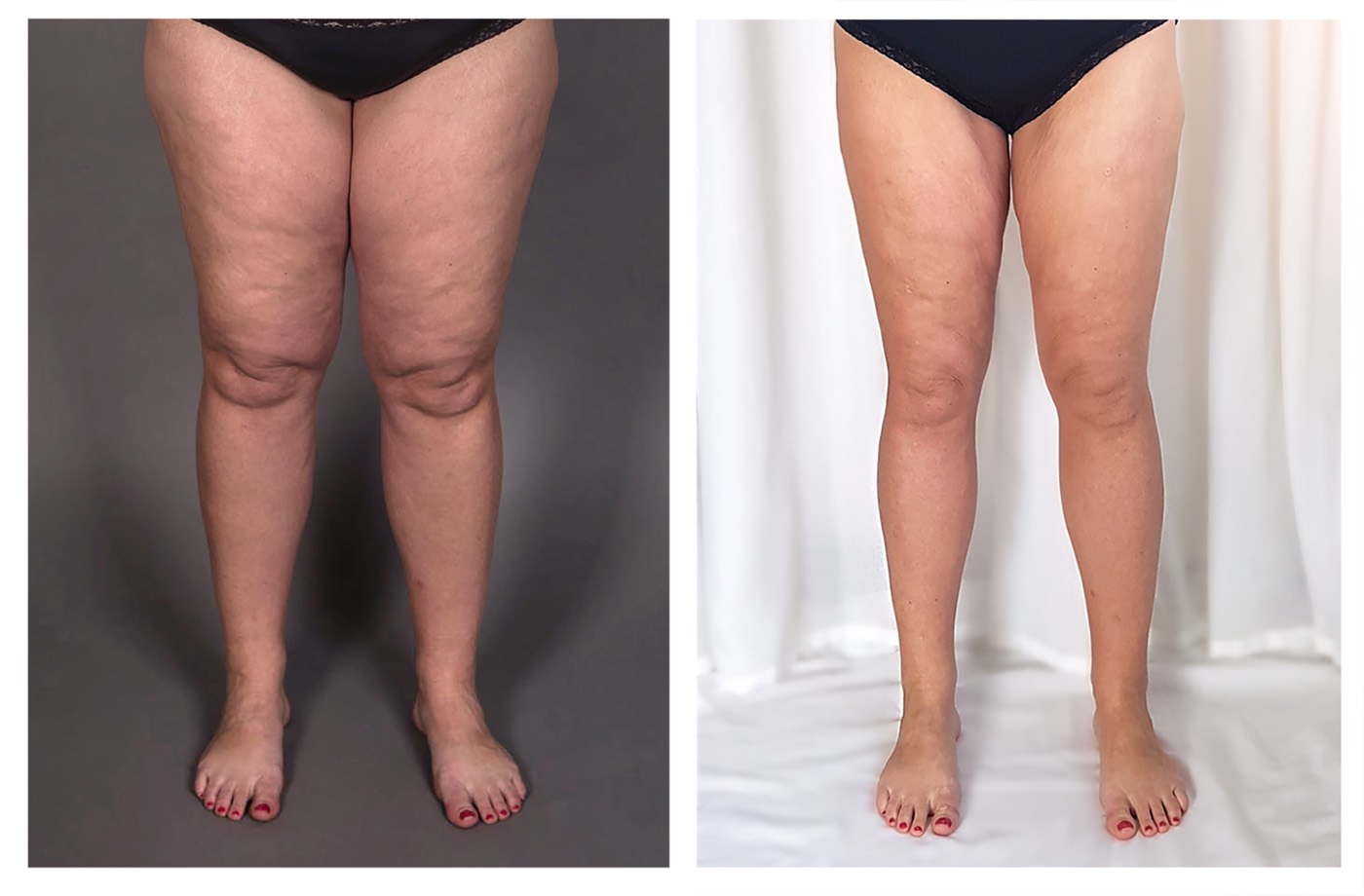
Lipedema (spelled lipoedema in the UK, Ireland and Australia) is an abnormal build-up of fat, usually in the legs and often the arms. It is painful to the touch, it bruises easily, and the pain and the disproportion remain even after weight loss. It is not obesity, and it is not something you caused.
Most people with lipedema have never been given the diagnosis by a doctor, and the ones who are usually get it late, often after years of being told to lose weight and come back. If that has been your experience, you are far from alone, because delayed diagnosis is one of the most consistent findings in lipedema research.
Where to start
Practices by country
Most people looking at this surgery leave their own state for it, and some leave the country. Filled countries have practices listed here. Click one.
United States · Europe · Latin America · Canada · Asia-Pacific · United Arab Emirates · All international
Browse every practice
Start with the full list and narrow it, jump straight to your state, or compare practices side by side on price, insurance and technique.
See the full list Compare surgeons
Arizona 5 · California 14 · Colorado 1 · Connecticut 1 · Delaware 1 · Florida 7 · Georgia 5 · Illinois 3 · Indiana 1 · Kentucky 1 · Louisiana 1 · Michigan 2 · Minnesota 1 · Missouri 2 · Nevada 1 · New Jersey 2 · New York 5 · North Carolina 1 · Oklahoma 1 · Pennsylvania 1 · South Carolina 1 · Tennessee 1 · Texas 8 · Utah 1 · Virginia 4 · Washington 3
Where the practices are
Half the country has no listed practice yet. Patients routinely travel for this surgery.
Questions answered by Dr. Josef Hadeed, MD, FACS
A double board-certified plastic surgeon on what separates lipedema surgery from cosmetic liposuction, what makes a good candidate, and why insurance approval stays difficult. Read his answers.
Worth reading first
- Do I have lipedema? A ten-question self-check.
The signs clinicians look for, in about a minute. Educational, not a diagnosis.
- Is it lipedema or just weight gain?
The four signs that separate them.
- My legs did not change on a GLP-1. Why?
A recognized route to diagnosis, and the evidence behind it.
- What do lipedema legs look like?
The five features, and what changes at each stage.
- Can lipedema be cured?
A straight answer, and what the treatments that exist actually do.
- Lipedema, cellulite or ordinary fat?
The signs that separate all three.
- Which practices publish a price?
Every US practice checked, and what each one says.
Tell us your state and we will let you know when a practice near you is added or verified.
Common questions
How many lipedema surgeons are there in the United States?
Only a few dozen US surgeons focus on lipedema, though a wider group of general plastic surgeons also offer the procedure. This directory lists every practice we can find, organized by state.
How much does lipedema surgery cost?
US practices that publish a price quote between $6,000 and $35,000, though not on the same basis: some quote per area, some per stage, some for a full course. A full course averages 2-3 surgeries and commonly totals $25,000-$100,000 or more. Most experienced lipedema surgeons are out of network, so plan for significant out-of-pocket cost.
Is lipedema surgery covered by insurance?
Coverage varies widely and initial denials are common, though most large US insurers now publish a written position on it, and UnitedHealthcare, Cigna and Aetna each have a formal policy. There is still no dedicated US diagnosis code for lipedema. A proposal for a lipedema code family (E88.83, with substages E88.831 to E88.839) has been before the CDC's ICD-10 Coordination and Maintenance Committee since September 2020 and was presented again in September 2024, September 2025 and March 2026, where the CDC's own topic packet describes it as “a revised proposal being presented for consideration” and states plainly that no specific code exists. Nothing has been finalized, and no effective date is settled, so any date circulating for it should be treated as unconfirmed. KFF found that fewer than 1% of denied in-network marketplace claims are ever appealed, yet insurers reversed roughly a third to nearly half of the denials that were appealed.
Is lipoedema the same as lipedema?
Yes, they are the same condition; lipoedema is the spelling used in the UK, Ireland and Australia, and lipedema is the US spelling. This site uses the US spelling and lists practices worldwide, including the UK and Australia.
How do I know if I have lipedema?
Common signs include legs that are painful to the touch, easy bruising, heaviness, and symmetric enlargement of the legs that typically spares the feet, often worsening at puberty, pregnancy, or menopause. In a national survey of 707 US women with the clinical picture, fewer than half (46%) had ever received a physician diagnosis. Only a clinician can diagnose lipedema; this site helps you find one.
Sources: diagnosis figures from the Lipedema Foundation Registry First Look report and a 2024 national survey of US women in Vascular Medicine; surgeries-per-course from Herbst et al., PRS Global Open 2021; appeal statistics from KFF marketplace claims analyses (2023, 2024). Cost figures from practices' own published pricing.