What lipedema feels like
As many as 1 in 9 US women may have lipedema (spelled lipoedema in the UK, Ireland and Australia), a figure advocacy organizations derive from a clinic-population extrapolation rather than a population study. In a national survey of 707 US women with the clinical picture, 46% had ever received the diagnosis from a physician. Many report being advised to lose weight instead.
What are the symptoms?
Tender when pressed, In the US Standard of Care, 80% of women with lipedema rate their pain at 5 or above out of 10. Pain is not required for the diagnosis, so its absence does not rule lipedema out. Its absence does not rule lipedema out.
Bruising appears with no injury you remember.
Both sides match, and the enlargement stops at the ankle, leaving a cuff.
The trunk loses more than the affected limbs, so the difference between them usually becomes more visible, not less, and the pain does not ease.
Alongside those four, a heavy aching that worsens through the day, and a waist that stays smaller than the limbs would suggest.
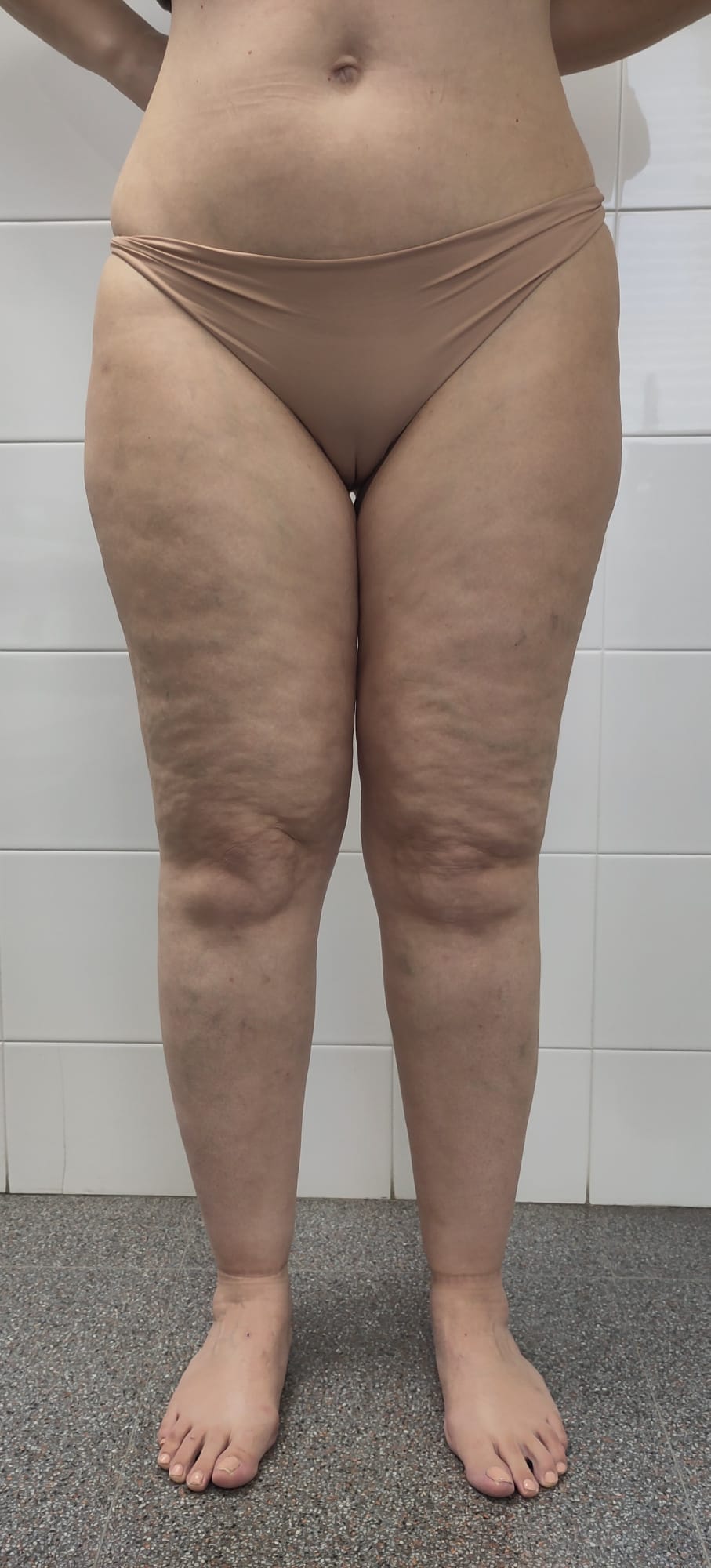
Is lipedema caused by diet or lack of exercise?
No. Lipedema is a disorder of adipose and loose connective tissue with a strong familial pattern, and onset clusters around puberty, pregnancy and menopause rather than around changes in eating or activity. It occurs in women across the whole weight range, including women who have never been overweight. Diet and exercise are part of managing it and neither causes it.
How is it different from ordinary weight gain?
Ordinary fat is not usually painful and does not bruise easily. Lipedema tissue often does both. It also responds differently to diet and exercise in a specific pattern: weight comes off the trunk more readily than off the affected limbs, so the disproportion between them usually becomes more pronounced and the pain does not ease. That mismatch is frequently the thing that finally gets taken seriously, and increasingly it surfaces during GLP-1 treatment, when substantial weight comes off and the symptoms do not follow.
How is it different from lymphedema?
Lymphedema usually affects one side, involves the foot, and pits when you press it. Lipedema is symmetric, spares the foot, and is painful. The two can coexist: untreated lipedema over many years can develop a lymphatic component, known as lipo-lymphedema. More on the difference.
What the signs point to
The pattern differs by where it sits and how far it has progressed: the legs, the arms, and what changes at each stage. The pinch test is the quick check clinicians use for tenderness.
This page is recognition information, not a diagnosis. Lipedema is diagnosed clinically by a physician who examines the tissue and takes a history, and no scan is required. If this describes you, the ten-question self-check takes about a minute, and the diagnosis guide covers who can name the condition and what the appointment involves.
Common questions
What are the symptoms of lipedema?
Legs and often arms that are painful to touch or pressure, bruise very easily, feel heavy, and enlarge symmetrically on both sides. The feet are typically spared, producing a cuff or bracelet effect at the ankle. The waist usually stays proportionally smaller than the limbs.
How is lipedema different from just being overweight?
Lipedema fat is painful, bruises easily, and is distributed symmetrically below the waist. Weight loss reduces fat across the body, the affected limbs included, but the pain, the tenderness and the disproportion persist. Many patients lose substantial weight and find the legs still hurt and still out of proportion, which is the pattern that most often finally prompts a diagnosis.
Is lipedema the same as lymphedema?
No. Lymphedema is a lymphatic drainage failure and is usually asymmetric, often involving the foot, and pits when pressed. Lipedema is a symmetric fat disorder that spares the feet and is painful. Long-standing lipedema can develop a secondary lymphatic component, called lipo-lymphedema.
Lipedema Central does not diagnose. Nothing here replaces examination by a clinician.
Find a practice · Lipedema and lymphedema
Updated