Is it lipedema or weight gain?
Four things separate lipedema from ordinary weight gain: it is symmetrical on both legs and often both arms, it is painful when pressed, it bruises easily with no remembered injury, and the pain persists when you lose weight. The feet and hands are typically spared, which produces an abrupt cut-off at the ankle.
If you have asked a doctor about your legs, you may well have been told to lose weight. For many women that answer turns out to be incomplete, and published estimates put the average delay to diagnosis at seventeen years.
As many as 1 in 9 US women may have lipedema, a figure advocacy organizations derive from a clinic-population extrapolation. In a 2024 national survey of women who fit the clinical picture, fewer than half had ever been given the diagnosis by a doctor. Registry data puts the average diagnosis at age 48, about 17 years after symptoms first appear. The gap largely reflects how closely lipedema can resemble ordinary weight gain to an untrained eye.
What does lipedema look like?
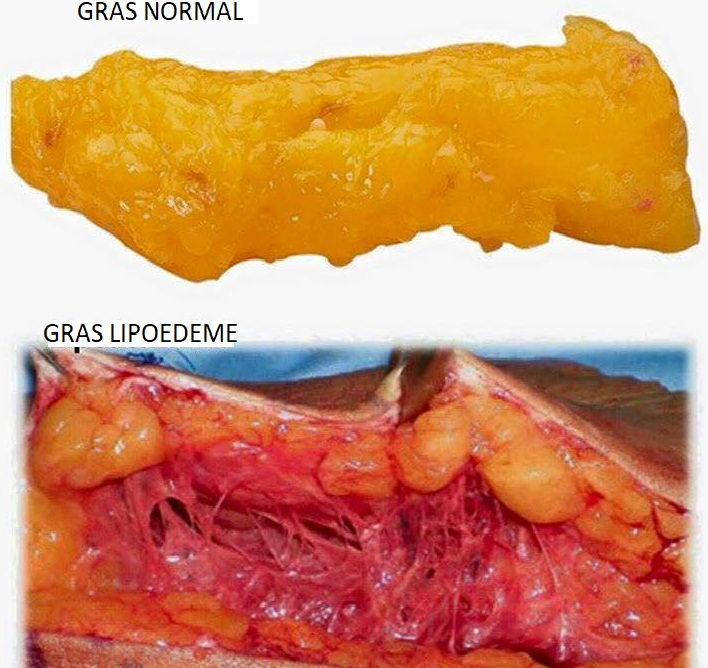
Symmetrical enlargement of both legs, often both arms, that stops abruptly at the ankles and wrists. The affected tissue is tender to pressure, bruises easily, and feels heavy. The upper body frequently stays proportionally smaller, which produces the column-shaped legs and the visible cuff at the ankle that clinicians look for.
| Lipedema | Ordinary weight gain | |
|---|---|---|
| Distribution | Symmetrical, both legs, often both arms | Follows your general body pattern, often includes the trunk |
| Feet and hands | Spared, with an abrupt cut-off at the ankle or wrist | Affected along with everything else |
| Pain on pressure | Commonly tender, sometimes severely | Not painful |
| Bruising | Bruises easily, often with no remembered injury | Normal |
| Response to weight loss | The trunk reduces more than the affected limbs, so the disproportion usually becomes more visible and the pain persists | Reduces roughly in proportion across the body |
| Onset | Tied to hormonal windows: puberty, pregnancy, menopause | Tied to intake, activity, medication, age |
When does lipedema usually start?
At hormonal transitions rather than gradually. Published figures put onset at puberty in 48%-59% of cases and at pregnancy in 21%-41%, with menopause accounting for around 2%. If your shape changed sharply around one of those events and never came back, that timing is itself diagnostic information worth telling a doctor.
Write down when it started relative to those events before any appointment. It is one of the highest-value pieces of history you can bring, and it is the kind of detail that gets lost in a fifteen-minute visit unless you arrive with it ready.
Can lipedema and obesity occur together?
Yes, and this is the most common reason the diagnosis is missed. The two coexist frequently. The presence of obesity does not rule lipedema out, and losing weight will not resolve the lipedema component. Treating them as mutually exclusive is a common source of years-long diagnostic delay.
Next steps
If more than two of the four signs above describe you, start with the ten-question self-check, then read who can diagnose it and what the appointment involves. There is no blood test and no scan that confirms lipedema, so this is settled by history and physical examination.
The full symptom picture, and how lipedema differs from lymphedema · What can be done about it
Common questions
How can you tell lipedema from weight gain?
Four signs separate them. Lipedema is symmetrical on both legs and often both arms. It hurts when pressed. It bruises with no remembered injury. And the pain stays when you lose weight, so the difference between your upper and lower body stays or gets worse as the rest of you gets smaller.
Does lipedema fat hurt?
Usually yes, and it is one of the clearest distinguishing signs when present. In the US Standard of Care, 80% of women with lipedema rate their pain at 5 or above out of 10, though the same document states pain is not an absolute requirement for diagnosis, so its absence does not rule lipedema out. Ordinary body fat is not tender to firm pressure. Lipedema tissue commonly is, and many people describe an aching heaviness through the day that worsens with standing and heat.
Why does lipedema spare the feet?
Lipedema affects the fat layer of the legs and arms but characteristically stops at the ankle and wrist, leaving the feet and hands unaffected. That abrupt cut-off, sometimes described as a cuff or bracelet at the ankle, is one of the features clinicians look for.
Sources
- Standard of Care for Lipedema in the United States, 2021.