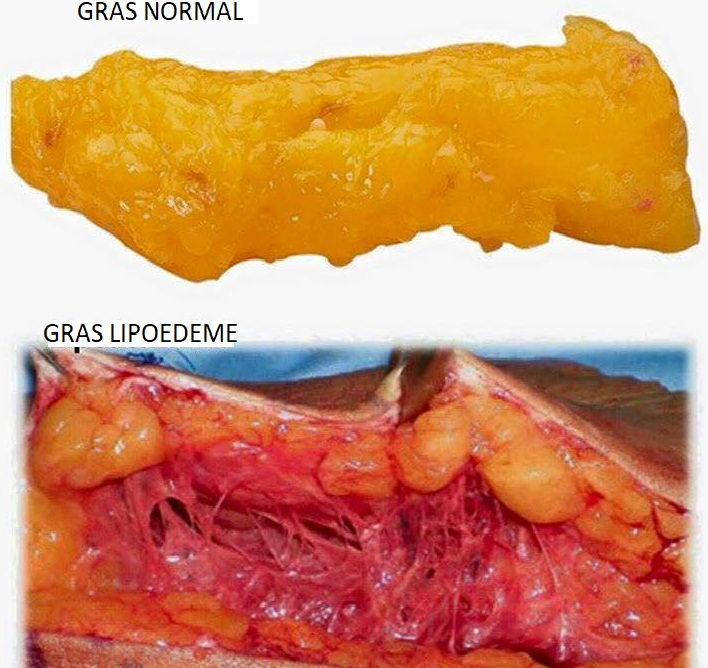
Lipedema vs cellulite vs normal fat
Cellulite is a surface texture that 80-90% of adult women have, it is painless, and it is not a disease. Lipedema is a disorder of the fat tissue itself: symmetrical, painful, bruises easily, and keeps hurting through weight loss. Pressure is the most useful quick test. Cellulite does not hurt when you press it, and lipedema usually does.
The three side by side
| Cellulite | Ordinary fat | Lipedema | |
|---|---|---|---|
| What it is | Skin texture caused by fat pushing through connective tissue | Normal adipose tissue | A disorder of the fat tissue itself |
| Painful to press | No | No | Usually yes, often markedly |
| Bruises easily | No | No | Yes, often with no remembered injury |
| Symmetry | Wherever fat sits | Varies by person | Almost always both legs, often both arms |
| Feet and hands | Not relevant | Involved proportionally | Spared, leaving a cuff at the ankle or wrist |
| Responds to weight loss | Often reduces somewhat | Yes, proportionally | Fat falls with the rest of the body; the proportion and the pain persist |
| Onset | Any time after puberty | Tied to intake, activity, age | Hormonal windows: puberty, pregnancy, menopause |
| How common | 80-90% of adult women | Universal | Estimates range widely; most cases are undiagnosed |
The ankle cuff is the clearest visual sign
Lipedema typically stops abruptly at the ankle and spares the foot, producing a visible step or bracelet where the enlarged calf meets a normally proportioned foot. Cellulite produces nothing like this, and ordinary weight gain involves the foot along with everything else. If a photograph shows enlarged legs above normally sized feet, that pattern alone is worth taking to a doctor.
The same applies at the wrist when the arms are affected, which happens in a large share of cases.
Why this gets dismissed as cellulite for years
Lipedema skin is frequently dimpled and nodular, so the surface appearance overlaps with cellulite closely enough that patients are told to lose weight and come back. Delayed diagnosis is one of the most consistent findings in the research on this condition, and the cellulite misread is a large part of why. Pain is the detail that separates them and the detail nobody asks about, because cellulite has never hurt anyone.
If you have been told it is cellulite and it hurts, that is a discrepancy worth raising directly.
What lipedema is not
It is not obesity, though the two frequently coexist. It is not lymphedema, which is fluid rather than fat, although long-standing lipedema can develop a lymphatic component. And it is not caused by anything the patient did or failed to do.
What to do next
The ten-question self-check covers the signs clinicians look for and takes about a minute. It is educational rather than a diagnosis. If the answers point that way, how to get diagnosed covers who can confirm it and what to bring to the appointment.
Full symptom picture · Lipedema or weight gain · Lipedema and lymphedema compared
Common questions
What is the difference between lipedema and cellulite?
Cellulite is a change in the appearance of skin, the dimpling produced when fat pushes against connective tissue bands. It affects an estimated 80-90% of adult women, it does not hurt, and it is not a disease. Lipedema is a disorder of the fat tissue itself: symmetrical enlargement of both legs and often both arms, painful to the touch, bruising easily, and keeping its proportion and its tenderness through weight loss. Someone can have both, and having cellulite says nothing about whether you have lipedema.
Does lipedema look like cellulite?
Lipedema skin often has a dimpled or nodular texture, which is why it is so often dismissed as cellulite. The difference is what lies underneath. Press the tissue: lipedema hurts and ordinary cellulite does not. Look at the ankle: lipedema typically stops abruptly above the foot, leaving a visible cuff. Look at proportion: lipedema legs are disproportionate to the upper body in a way cellulite never causes.
How do you tell lipedema from ordinary weight gain?
Four things. Lipedema is symmetrical on both sides. It is tender or painful when pressed. It bruises with no injury you remember. And the pain does not go when you lose weight, so the difference between upper and lower body stays or worsens as the rest of you gets smaller.
Can you have lipedema and obesity at the same time?
Yes, and it is common. They are separate things that frequently coexist, which is a large part of why lipedema goes undiagnosed for years. Weight loss reduces fat across the body, the affected limbs included, and the proportion and the pain persist, and the disproportion that remains is often the clearest sign that something else is going on.
Sources
- Standard of Care for Lipedema in the United States, 2021.