Lipedema legs
Lipedema legs are enlarged symmetrically on both sides, disproportionate to the upper body, painful when pressed, and bruise easily. They stop abruptly at the ankle, leaving normally sized feet and a visible cuff. The pain and the disproportion persist through weight loss, which is what separates them from ordinary weight gain.
The five features that identify them
| Feature | What it looks and feels like |
|---|---|
| Symmetry | Both legs affected to a similar degree. One-sided enlargement points somewhere else. |
| The ankle cuff | Enlargement stops above the foot, leaving a visible step or bracelet at the ankle. The feet stay normally sized. |
| Pain on pressure | Tender or painful when pressed, sometimes aching at rest. Ordinary fat is not usually tender. |
| Easy bruising | Bruises appear with no injury you remember, from small capillary fragility in the tissue. |
| Disproportion | Lower body noticeably larger than upper body, and the gap persists or widens with weight loss. |
Texture is a supporting sign rather than a defining one. Lipedema tissue often feels cool and doughy, and the skin surface can be dimpled or nodular, which is why it is so frequently dismissed as cellulite. How to tell them apart.
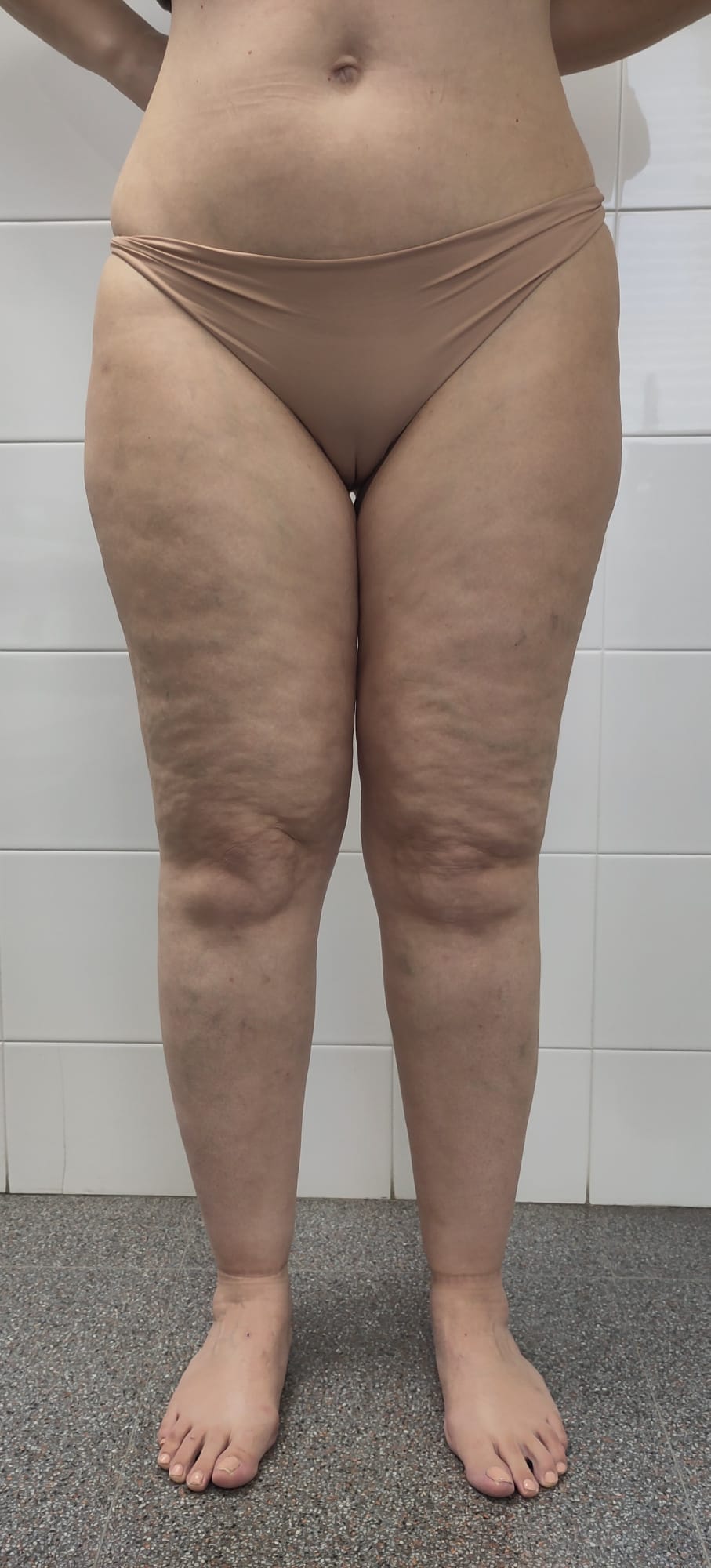
The stages, and what changes between them
| Stage | What the legs look like |
|---|---|
| Stage 1 | Skin surface still smooth. Enlargement and disproportion present, tissue tender, bruising already common. |
| Stage 2 | Surface becomes uneven and nodular, with a mattress-like texture. Pain typically more pronounced. |
| Stage 3 | Large lobes of tissue, often at the thighs and knees, which can distort the shape of the leg and interfere with walking. |
| Lipo-lymphedema | A lymphatic component develops on top of the lipedema. Swelling now involves the foot, which the earlier stages spare. |
Stages describe appearance rather than severity of symptoms. Pain in stage 1 can be worse than pain in stage 3, because pain does not track the degree of disproportion.
Where else it appears
The arms are involved in a large share of cases, with the same pattern: symmetrical enlargement stopping at the wrist and sparing the hands. Some people have arm involvement without recognizing it, because the legs draw the attention.
Why the legs are usually the reason someone finally gets diagnosed
Most people with lipedema have never been given the diagnosis, and when it does come it is usually the legs that prompt it: legs that hurt, legs that keep hurting through years of dieting, legs that look nothing like the rest of the body. Delayed diagnosis is one of the most consistent findings in the research on this condition.
If that describes you, the ten-question self-check covers the signs clinicians look for and takes about a minute. It is educational rather than a diagnosis.
What can be done
Conservative care, meaning compression and manual lymphatic drainage, manages pain and swelling and is what most insurers require before they will consider anything else. It does not reduce the fat. Surgery reduces volume and is usually staged across two to three operations. Both options in detail, and every practice we can identify that performs the surgery.
Full symptom picture · How to get diagnosed · Stages of lipedema · Lipedema in the arms
Common questions
What do lipedema legs look like?
Symmetrically enlarged on both sides, disproportionate to the upper body, and stopping abruptly at the ankle so the feet stay normally sized. The skin often looks dimpled or nodular, and the tissue feels cool and doughy rather than firm. The cuff at the ankle is the single most recognisable feature and is the detail that separates it from ordinary weight gain, which involves the foot too.
Why do my legs hurt but look like fat?
Because lipedema tissue is not ordinary fat. It is painful on pressure, aches spontaneously, and bruises with no remembered injury. Pain is the symptom patients rank as most disabling and the one most often left out of the conversation. In the US Standard of Care, 80% of women with lipedema rate their pain at 5 or above out of 10, though the same document states pain is not an absolute requirement for diagnosis, so its absence does not rule lipedema out. Legs that are enlarged and painful are worth describing to a doctor in exactly those terms.
Do lipedema legs get worse over time?
They can, though not inevitably. In one published series about two-thirds of women were stable over time, and where progression did occur it correlated with weight gain. Hormonal transitions such as menopause are also described as triggers. The condition is described in stages: smooth skin with enlargement in stage 1, an uneven nodular surface in stage 2, large deforming lobes of tissue in stage 3, and lipo-lymphedema when a lymphatic component develops. Progression is variable and many people remain in one stage for years.
Will losing weight fix lipedema legs?
No, and the way they fail to respond is itself diagnostic. Weight loss reduces fat throughout the body while lipedema tissue largely stays, so the disproportion between upper and lower body often looks worse after weight loss rather than better. That pattern is one of the clearest signals that what is present is not simply excess weight.
Can lipedema affect only one leg?
Almost never. Symmetry is a defining feature, and enlargement of a single limb points toward lymphedema, a venous problem or another cause. Asymmetric swelling is worth prompt medical assessment rather than a lipedema assumption.
Sources
- S2k-Leitlinie Lipödem, AWMF register 037-012, version 5.0, January 2024.
- Standard of Care for Lipedema in the United States, 2021.