What can be done about lipedema
There is currently no cure for lipedema and no drug that removes the tissue. There are two approaches that help, they do different jobs, and most patients end up doing both.
Conservative management
This is first-line treatment for every stage. It controls swelling and reduces pain and heaviness. It does not remove lipedema tissue; no conservative treatment does.
It is ongoing rather than a course you finish, and the parts work together: compression is the core and the part with the strongest evidence behind it, movement supports it, and skin care protects the limb as folds develop.
Daily wear, replaced every few months. The single most consistent part of care.
From a certified therapist, where compression alone does not relieve pain, or where a separate edema is also present. Its goal is pain relief rather than reducing volume.
Walking, swimming and low-impact work support the lymphatic system.
Keeping skin intact matters more as folds develop and infection risk rises.
Compression is daily and garments are replaced every few months, so conservative care is a running cost rather than a one-off. Manual lymphatic drainage is a repeating appointment where it is indicated, though current German guidance treats it as an option for pain relief rather than a standard part of care for everyone.
Conservative treatment is also the gate. Payer policies require documented failure of conservative management before they will consider surgery. Three consecutive months is the usual requirement. Some plans want six, and some add a separate weight-loss requirement on top, so read your own policy. If you think surgery is anywhere in your future, start the documentation now. Dated records of compression use and drainage appointments are what a future claim is built on, and they carry far less weight if reconstructed after the fact. How the insurance clock works
The drainage and the garment fitting come from a certified lymphedema therapist, and so does the documentation. Find a LANA-certified therapist in your state.
Does weight loss treat it?
Not by itself. Weight loss can reduce fat throughout the body, the affected limbs included, but the pain, the tenderness and the disproportion between limbs and torso persist, which is what separates this from ordinary weight gain. Losing weight can improve mobility, general health and surgical candidacy, and some practices require it before operating. Being told to lose weight and come back is the most common reason women spend years without a diagnosis. GLP-1 medications have made the pattern more visible: the weight comes off and the legs and the pain stay.
Surgical reduction
Surgery is currently the only treatment shown to remove lipedema tissue. The LIPLEG randomized trial reported 68% of surgical patients achieving meaningful pain reduction at its 12-month primary endpoint, against 8% on conservative care alone. That is the strongest evidence in the field and the number most appeal letters are built on. That 8% is one specific outcome, a two-point drop in leg pain within a year, not a verdict on whether conservative care is worth doing. Conservative care is managing swelling, heaviness and mobility, which that endpoint does not measure.
The same trial recorded adverse events in 47% of the patients who had liposuction, 8% of them serious, against 21% and 3% in the conservative therapy group. Reported complications include bleeding, anemia, infection, blood clots, tissue fibrosis and lymphedema. Surgeon-reported series from high-volume German centres put the overall complication rate near 3%, so the published range is wide, and it is a question worth putting to any surgeon directly.
Sources: Podda M et al., LIPLEG randomised trial, Lancet 2026, for both the 68% result and the adverse-event figures; Herbst KL et al., PRS Global Open 2021, for the complication list and the average course length; Cornely & Gensior, Dermatologie 2024, for the German surgeon-reported rate.
That trial carries more weight than a single study normally would, because of who commissioned it and what they did next. Germany's federal joint committee, the G-BA, ordered the trial, reviewed its results, and on 17 July 2025 voted to cover lipedema liposuction at every stage rather than only the most severe. Germany's benefits regulator reviewed that evidence and changed its national coverage rules. That decision does not bind a US insurer, and US policies rest on their own evidence review, but the underlying trial is the strongest published evidence in the field. How to use it in an appeal
What it involves in practice: a lipedema-specific liposuction technique, done in stages rather than one operation. Published research puts the average course at 2-3 surgeries. Compression continues afterwards, and conservative management does not stop when surgery is done.
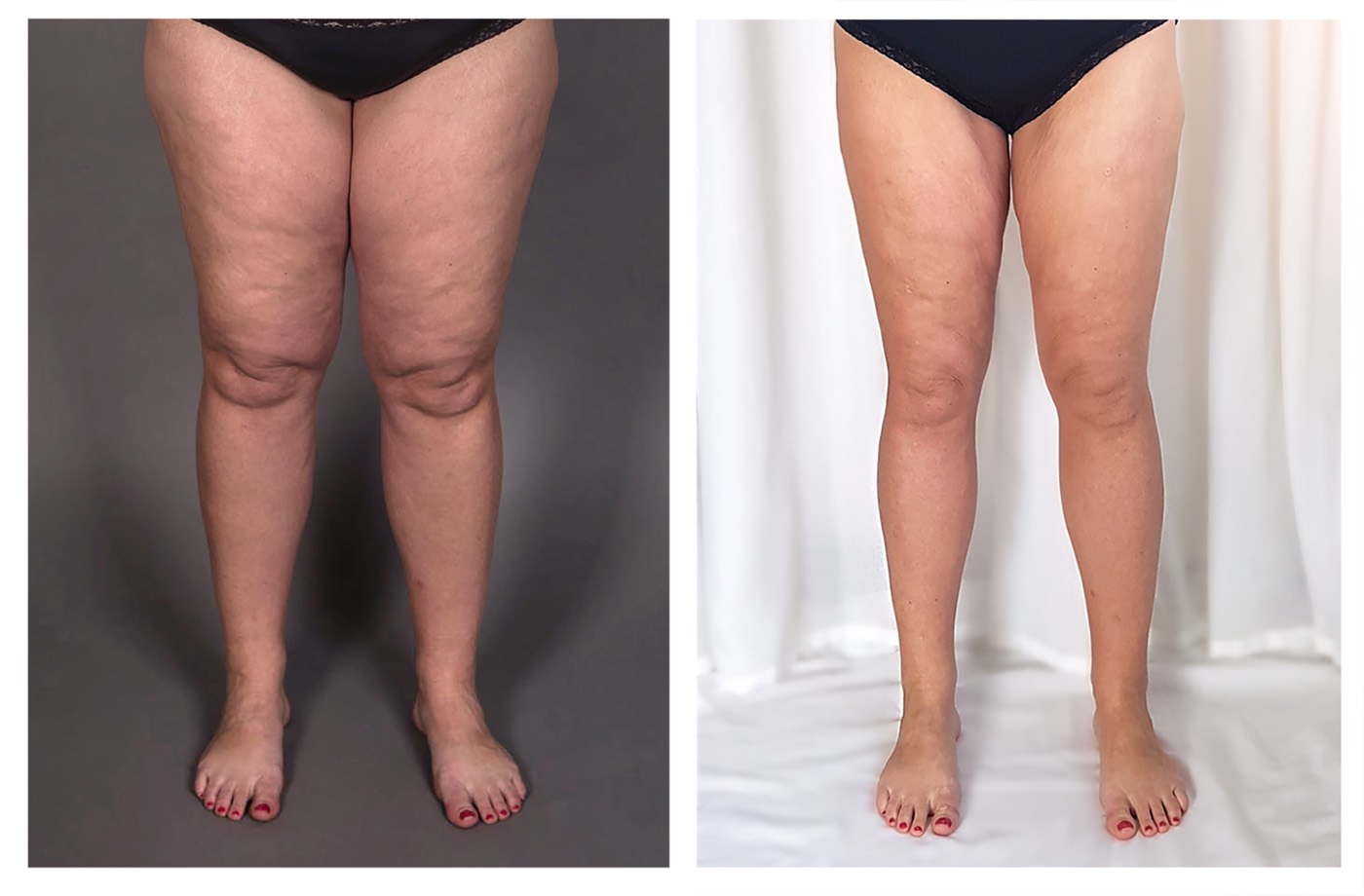
The technique the surgeon uses is a clinical choice, because this is high-volume work on tissue threaded with lymphatic vessels. Some listed practices publish that they use lymphatic-sparing technique, and whether a practice discusses lymphatics at all is a reasonable early signal of its familiarity with lipedema-specific technique.
The surgical techniques, and which practices name each one · Technique and anesthesia by practice, side by side
“Liposuction for cosmetic reasons involves soft fatty tissue, whereas liposuction for lipedema involves treating tissue that is fibrotic, fragile, and vascular. The goal of cosmetic liposuction is an improved appearance to the treated area. The goal of lipedema liposuction is not only an improved appearance, but symptom reduction and functional improvement. A good lipedema surgeon will not debulk the extremity, but rather sculpt it.”
Dr. Josef Hadeed, MD, FACS,
Choosing between them
Before that: compression and manual lymphatic drainage are the two halves of conservative care, diet manages symptoms without removing tissue, and no treatment cures the condition.
Roughly in this order. Get the diagnosis and the stage written into your record. Start conservative management and document it from day one. Work out what a full course would cost you and whether your plan has a lipedema policy. Then build a shortlist of surgeons and use consults to test them, rather than deciding on a website.
Questions worth asking on a consultation
What it costs · Whether insurance will pay · Find a surgeon
Common questions
Can lipedema be cured?
No. There is no cure and no drug that removes lipedema tissue. Treatment is about controlling symptoms and, where it is warranted, surgically reducing the affected fat. Conservative management controls swelling and pain but does not remove the tissue.
What is conservative treatment for lipedema?
Compression garments, manual lymphatic drainage, movement and exercise, skin care, and weight management where relevant. It is first-line for everyone, it helps with pain and swelling, and it is also the documentation insurers require before they will consider surgery.
Does weight loss fix lipedema?
No. Weight loss can reduce fat throughout the body, including the affected limbs, but it does not resolve the pain, the tenderness or the disproportion between the limbs and the torso, and it does not remove the disease. Losing weight can improve overall health and mobility and may be required before surgery. Being told to lose weight and come back is a common reason women are dismissed for years before diagnosis.
Is surgery the only thing that removes lipedema fat?
Yes. Surgical reduction, usually a lipedema-specific liposuction technique, is currently the only treatment shown to remove the affected tissue. The LIPLEG randomized trial reported 68% of surgical patients achieving meaningful pain reduction at its 12-month primary endpoint, against 8% on conservative care alone. That 8% is one specific outcome, a two-point drop in leg pain within a year, not a verdict on whether conservative care is worth doing. Conservative care is managing swelling, heaviness and mobility, which that endpoint does not measure.
General information, not medical advice. Lipedema Central has no clinicians and does not provide clinical care. Treatment decisions belong with you and your physician.
Updated